
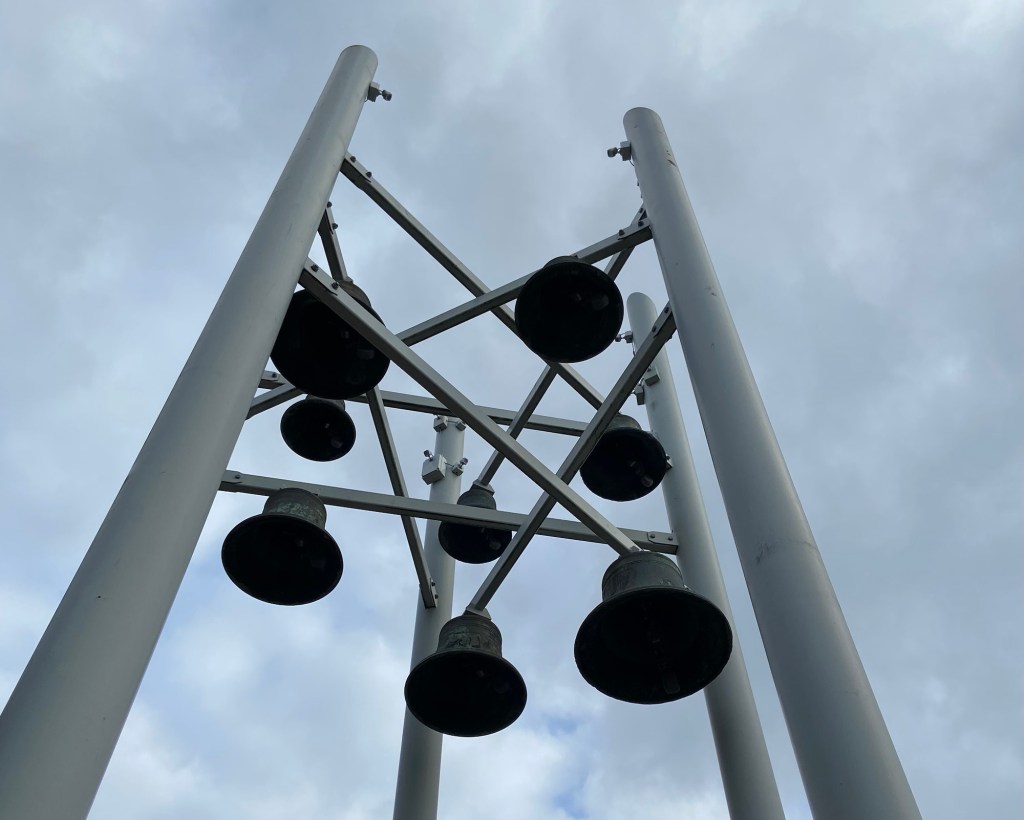
Middlesbrough has a habit of knocking down its finest buildings, with the Royal Exchange, Cleveland Scientific Institute, Odeon and others becoming either flyovers or car parks. Another victim of this trend was the demolition of St. Hilda’s Church in 1969 – over 130 years after its erection in 1838. The church dominated the skyline of north Middlesbrough, featuring as a looming, gothic presence in L.S. Lowry’s famous painting of the St. Hilda’s area.

But – like the Keystone Heads of the Royal Exchange – a part of the church remains. The bells of St. Hilda’s can still be seen above your head in Boro town centre.

Originally cast in bronze by Mears and Stainbeck of London in 1864, the bells were inscribed with the names of the firms and dignitaries that sponsored their production (church bells being – presumably – not cheap). Included in their number were local magnates Thomas Vaughan and Joseph Pease.
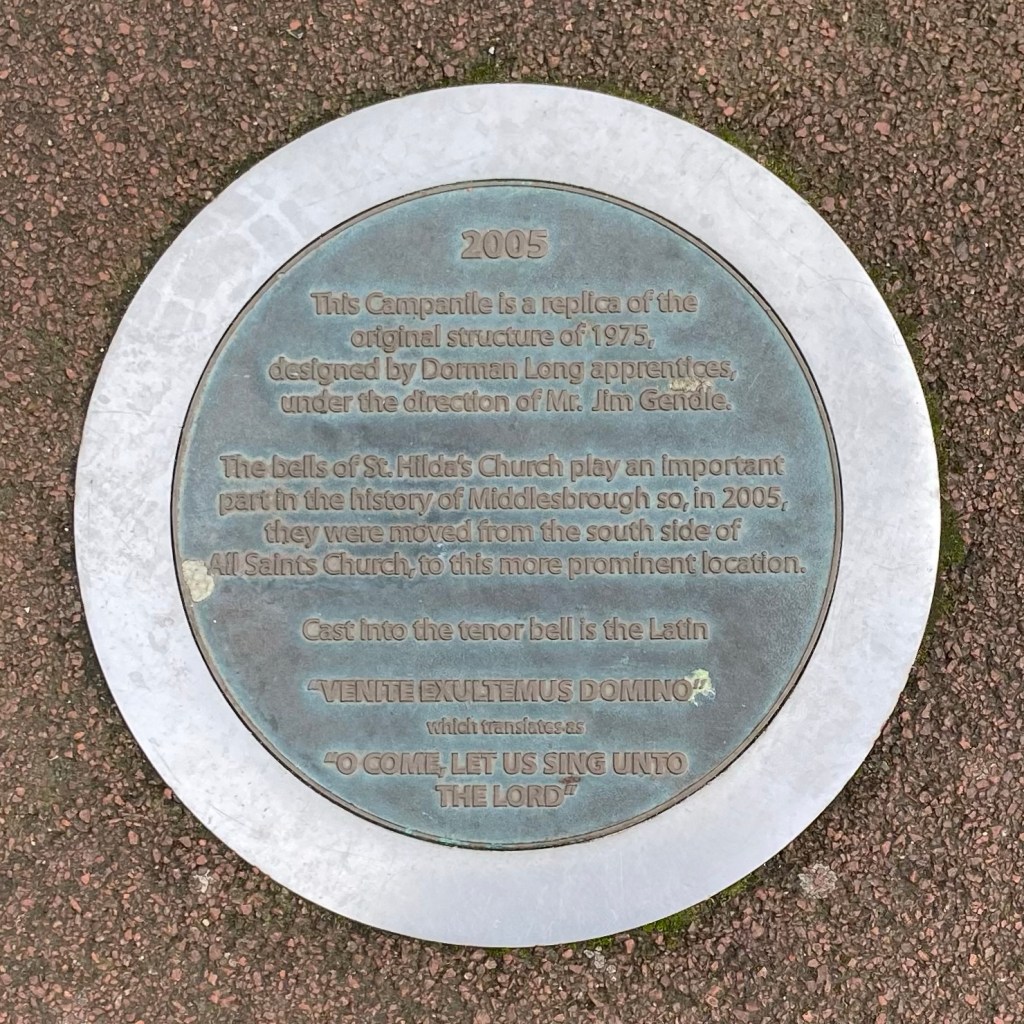
When the church was finally demolished, the bells were kept in storage until 1975 when they were placed on a steel campanile (or bell tower to the layperson) designed by Dorman Long’s Jim Gendle. This allowed them to ring again, but was tucked away behind All Saints Church (which is now next to the Cleveland Centre).
In 2005, the campanile was moved to a more visible location on Grange Road (via the Middlesbrough Town Centre Company), where it now stands. There was some delay in sourcing the striking parts from Belgium, but eventually the inhabitants of Middlesbrough were able to hear a piece of local history ringing out again.



Photos by Daniel Cochran
 North East Statues