

John Vaughan was one of Middlesbrough’s founders and mayors, and – on June 2nd 1884 – he got his statue in the town (just a few years after his partner Henry Bolckow). The bronze statue was the work of George Anderson Lawson, and was unveiled at Exchange Place by the namesake son of railway pioneer Joseph Pease.

The time of the unveiling was one of struggle for the people of Middlesbrough, unemployment was high and families were struggling to feed themselves on low wages. This poverty was so pervasive that Pease was even obliged to mention the situation in his unveiling speech:
“[A]t this moment a considerable amount of distress exists in this district. These are words easily said, but they mean a great deal in many a cottage home when bread is wanting, and the comforts of life are decreasing, and many and many an honest man has to go across the sea to earn the bread that he would be ready to work hard for at home.”
(The North Eastern Daily Gazette, Monday June 2nd, 1884)

To anticipate public dissatisfaction about an expensive statue being erected during a time of want, frequent mentions were made in the speeches about how the statue was paid for with private funds. Pease opened his speech thanking the “subscribers to this memorial”, before announcing that Vaughan’s widow Ann had, “forwarded £150 to be distributed amongst the poor people of Middlesbrough on her behalf – a generous aid from a kindhearted old lady”.
But this solemnity was hardly befitting the unveiling of a statue, so Pease’s speech to pains to remind the assembled crowd of the many achievements birthed in Middlesbrough:
“When you consider that your manufactures are those which have made our railroads, built those wonderful bridges which may be said to unite countries – that wonderful industry which drives those steamships of which England is so proud across the bosom of the deep, you will feel the importance of the trade in which everyone of you is interested, and which he (pointing to the statue in this district did so much to originate (Applause.)”
He even reminded the crowd of the legend which directly attributed the town’s birth to, “the accident of Mr Vaughan stumbling across a piece of ore whilst on the hills, and that that accidental discovery resulted in the marvellous development of the wealth of Cleveland.”
The statue was moved to Centre Square in 1914, separating Vaughan and Bolckow’s statues.

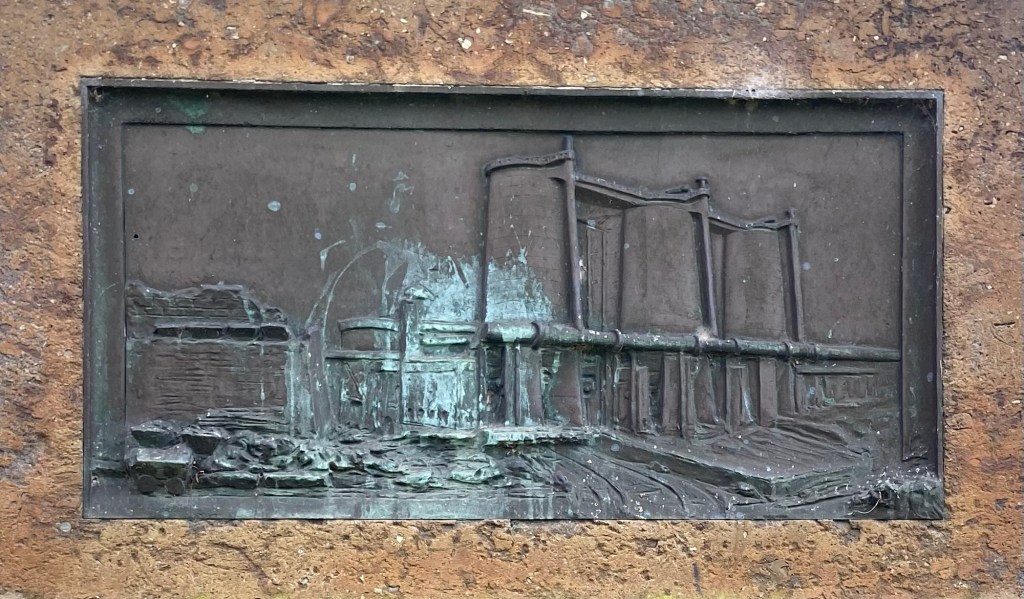
It stands on a plinth (fittingly) of ironstone, with four slightly worse-for-wear bronze bas-relief panels on each of its sides, showing Eston mine-head and Eston Nab, blast furnaces, the rolling mills and the railways and ships used to transport the iron. The inscription on it reads:
‘John Vaughan 1799–1868 Mayor of Middlesbrough 1855 discovered ironstone in the Cleveland hills founder of the iron trade in Middlesbrough. Partner of Bolckow, Vaughan & Co. who built one of the first iron works in Middlesbrough in 1840.’



 North East Statues