

Early architecture in Middlesbrough was often an exercise in myth building. As a new town, Middlesbrough had a fairly blank slate to create its own story and define itself on its own terms. In doing this, architects and sculptors often chose to blend classical motifs with images of industry.
We’ve already seen this at work when discussing the Keystone Heads that once adorned the late lamented Royal Exchange building, and another 19th Century example can be found in the stone portico above the doors of the former National Provincial Bank – now Boho Four Gibson House – on Cleveland Street.
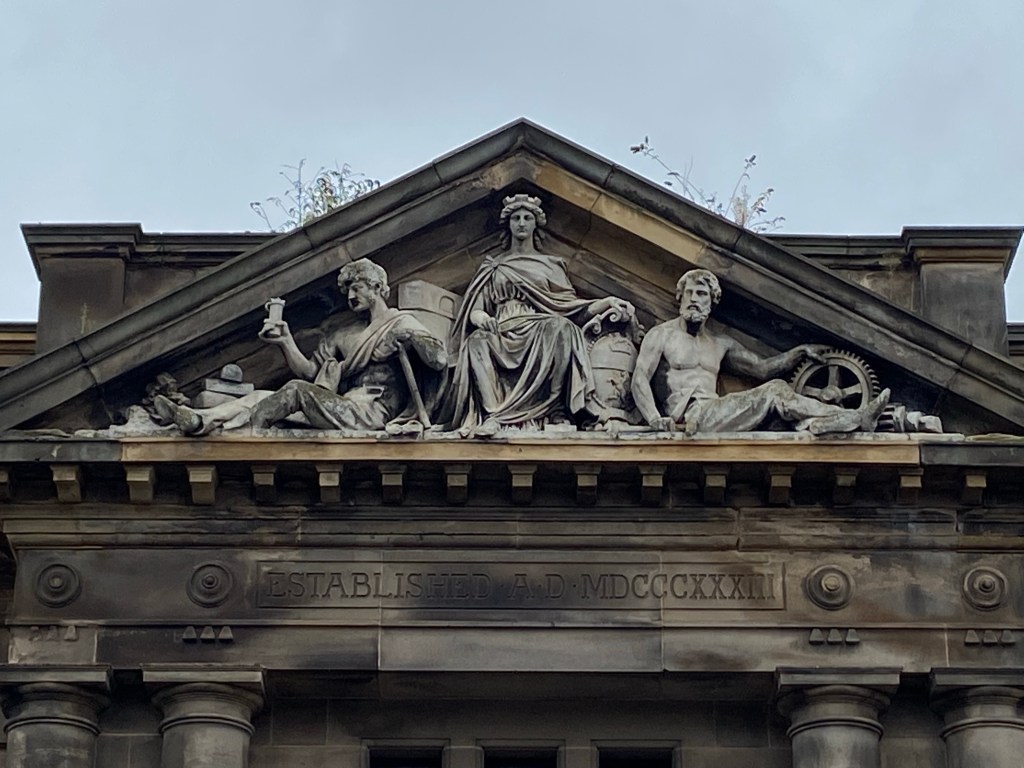
According to Paul Usherwood and Jeremy Beach’s book, Public Sculpture of North-East England (known to us as the pink bible of local sculpture), the bank was built opposite the house in which town founders Henry Bolckow and John Vaughan lived from 1841 to 1860. It makes perfect sense then that the patriotic seated figure of Britannia is flanked by idealised representations of both a miner (on the left) and an ironworker (right), along with the tools of their trade.


Although the building was completed in 1872 by architect John Gibson, Usherwood and Beach suggest that the sculptor of the portico was one Charles Henry Mabey (1835-1912), who is most notable for modelling the sphinxes for Cleopatra’s Needle.

After the bank moved to new premises on Albert Road (see our article on its wonderful brass doors), the old building went through several iterations (most notably the Cleveland Club). It now serves as Boho Four, Gibson House.
Sources
https://www.streathamsociety.org.uk/blogs–posts/the-sculptor-charles-henry-mabey
Public Sculpture of North-East England (Paul Usherwood & Jeremy Beach)
 North East Statues
One thought on “National Provincial Bank Portico (Middlesbrough, possibly C.H. Mabey, 1872)”