

Legend has it long ago a “merperson” was captured by the residents of the coastal village Skinningrove. In 2012 Saltburn based freelance artist Glynis Johnson worked with pupils from Whitecliffe Primary School to immortalise him in art!
The tale of the Skinnigrove merman is one of East Cleveland’s most popular folk tales. The story dates back to the late 1400s when it was said that a fish-like creature was caught in the nets of local fishermen. Unable to speak, its only means of communication was by means of a loud shriek! The “seaman” was kept in a house in the village for several weeks where the people of Skinningrove fed him. A rather fussy eater, the Merman would only eat the raw fish provided for him and earned a reputation as a bit of a lady’s man! When in 1535, a Mr. Wells wrote down the story of the Skinningrove Merman, (so it would be taken seriously) he noted, ‘ fayre maydes were wellcomest guests to his harbour, whome he woulde beholde with a very earneste countenaynce, as if his phlegmaticke breaste had been touched with a sparke of love.‘ Nonetheless, even with his reputation, he was respected by the community and was eventually let out of captivity. However, he saw this newfound freedom as an opportunity to go back to the North Sea and alas departed Skinningrove!


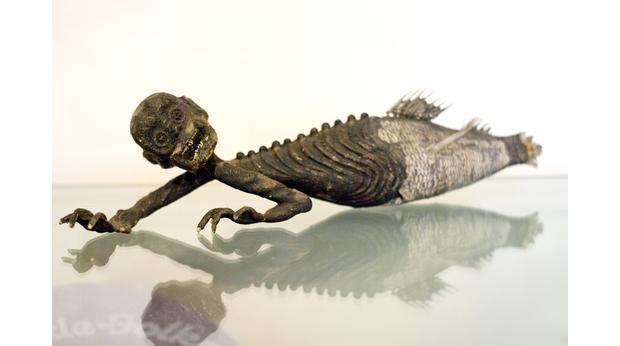
There is sadly no description of the Merman’s physical appearance in Mr. Well’s 16th Century account but you could assume it had a fish-like tail and a human-like torso, for such mythical creatures have been recounted in folklore throughout the world and in popular culture. They were even recorded by the Royal Navy throughout the 19th Century! The fascination with “merpersons” became so popular during this period that in 1859 showman P.T. Barnum exhibited one in London! His Fiji Mermaid was sadly not real though, but rather a creation by Japanese fishermen. A similar hybrid is on display locally at the Hartlepool Museum. Herman, as he is known, is constructed from the body of a monkey and the tail of a fish. A convincing alien being, you can see how easy it was to believe such beasts existed.
Thankfully the Merman mural on the Riverside Building in Skinningrove is visually stunning and not as vulgar as Herman. Funded by Coast & Country Housing’s Your Way You Say scheme which, ‘supported projects benefitting the community, or enhancing the environment.’ The mosaic on the side of the former village Primary School was the idea of a pupil and member of staff from Whitecliffe Primary School in Carlin How. The magical Merman was brought to life by ceramist Glynis Johnson.

Having previously worked with Whitecliffe Primary School children on a Friendship Bench consisting of ceramic tiles. For this project, Johnson drew up the image of the Merman and then had all the pupils design a tile that made up the mosaic, with the reception class pressing shells into the merman’s hair to leave imprints. Notably, the toned physic of the “lady’s man” was sketched from an Action Man for Glynis couldn’t get anyone to pose for her!

Unveiled in 2012 by then Redcar and Cleveland Mayor Olwyn Peter. Coast & Country Chief Executive, Iain Sim told the Teesside Gazette at the time,
‘We see community involvement as extremely important and the mosaic the pupils have helped create will be an artistic asset to the area for many years to come…The merman legend is part of East Cleveland’s heritage and the pupils are to be commended for the thought, imagination and hard work they’ve put into bidding for finance and then creating this eye-catching piece of artwork.’


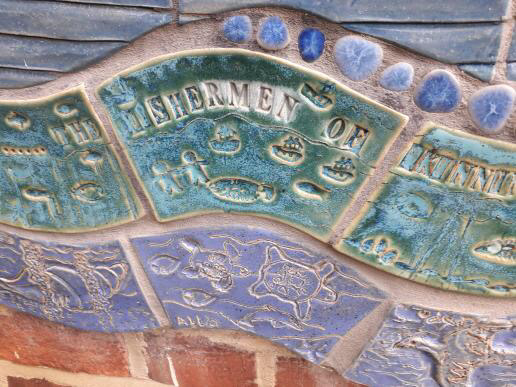


Unfortunately, the Riverside Building is looking slightly overgrown and parts of the mural can’t be seen unless up close. However, Glynis tells us that she has informed the local councillor who will sort out some pruning! She also worked on a second mosaic for the building the same year as the Merman marking the 2000 flooding that devastated Skinningrove, but that’s a tale for another North East Statues post.
 North East Statues
One thought on “The Skinningrove Merman Mosaic (Skinningrove, Glynis Johnson & Pupils of Whitecliff School, 2012)”